This website uses cookies
We use cookies to ensure that we give you the best experience on our website. If you continue to use this site we will assume that you are happy with it.


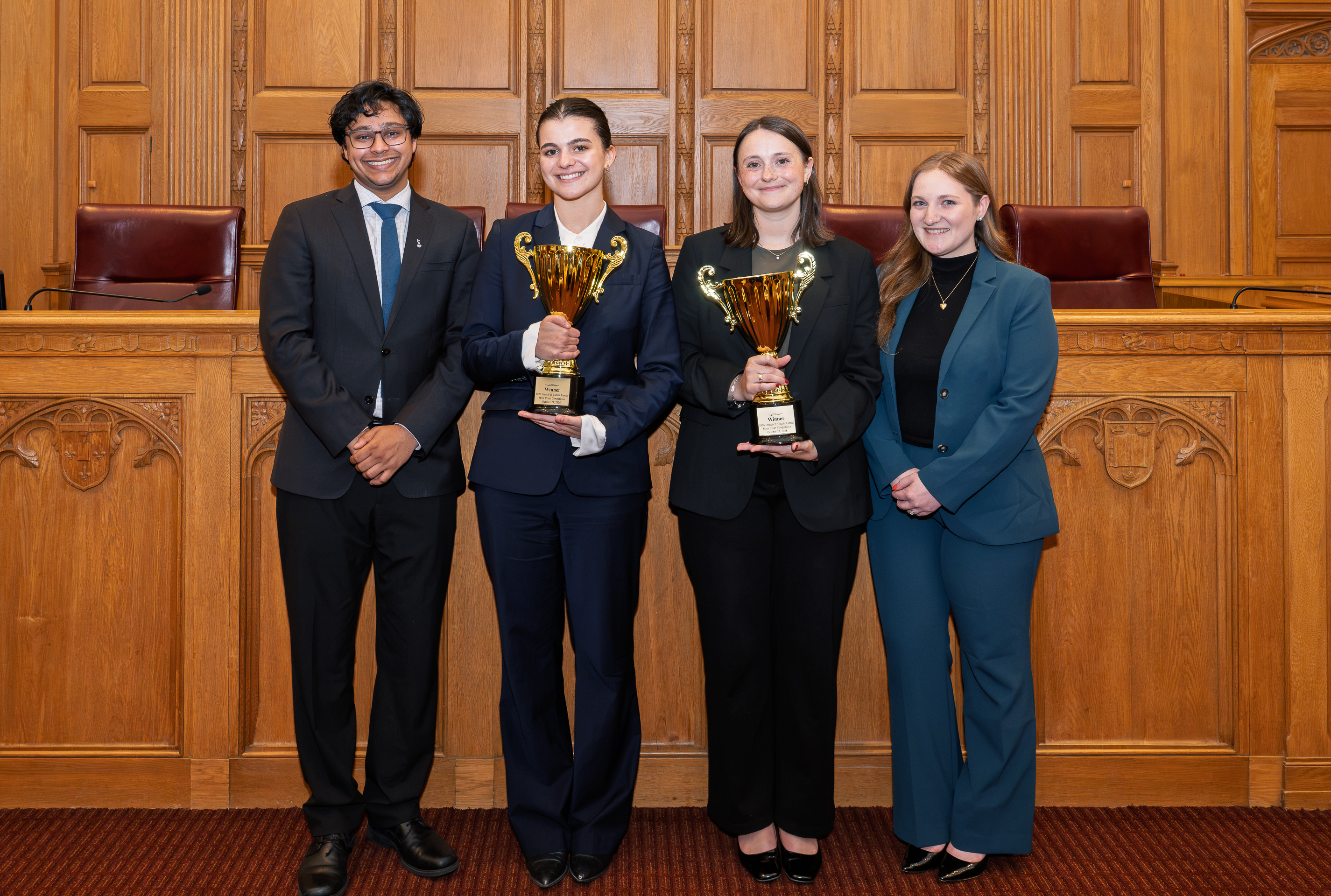
On Saturday, October 24, members of the Law School community gathered in the MacDonald Moot Court Room for the final round of the 49th annual Francis P. Cuccia Family Moot Court Competition. Weeks of preliminary and elimination rounds with more than fifty competitors culminated in final teams Finn McGaan ‘28 and Leonardo Villa-Forte ‘27, arguing on behalf of the petitioner, and Clarisse Allehaut ‘28 and Abigail Srulevich ‘28, arguing on behalf of the respondent. After their convincing arguments in front of a lively panel of federal judges, Clarisse Allehaut and Abigail Srulevich emerged as the 2026 Cuccia Cup Champions.
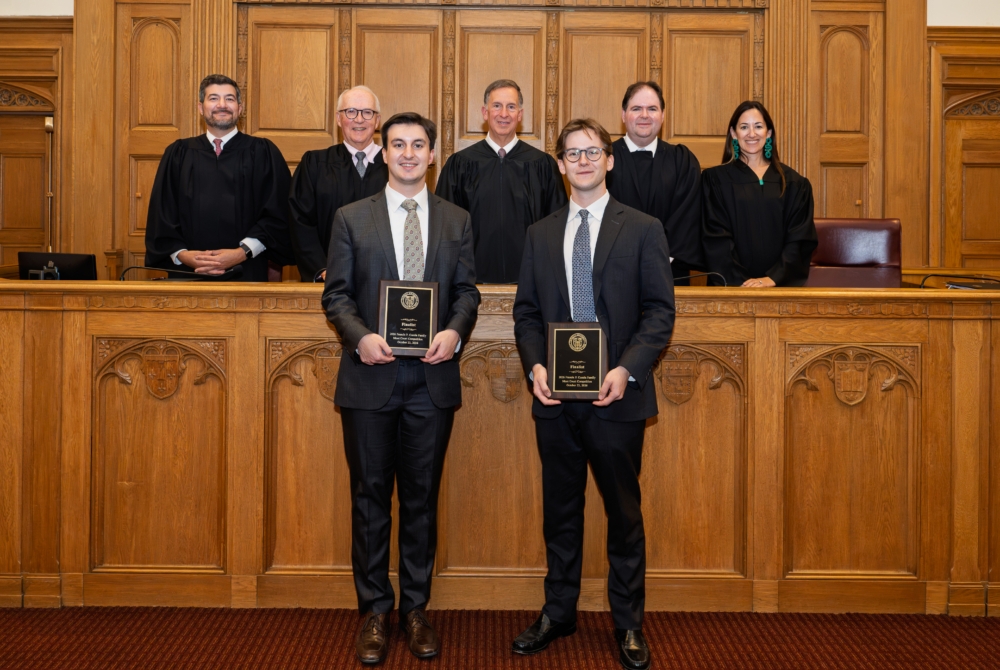
(Back row L to R): Judge Rodolfo Ruiz, Judge Richard C. Wesley, Chief Judge Michael Chagares, Judge Robert Luck and Judge Stacey D. Neumann
(Front row) Cuccia Cup runner ups (L to R): Finn O’Dwyer McGaan & Leonardo Costa Lins Villa-Forte
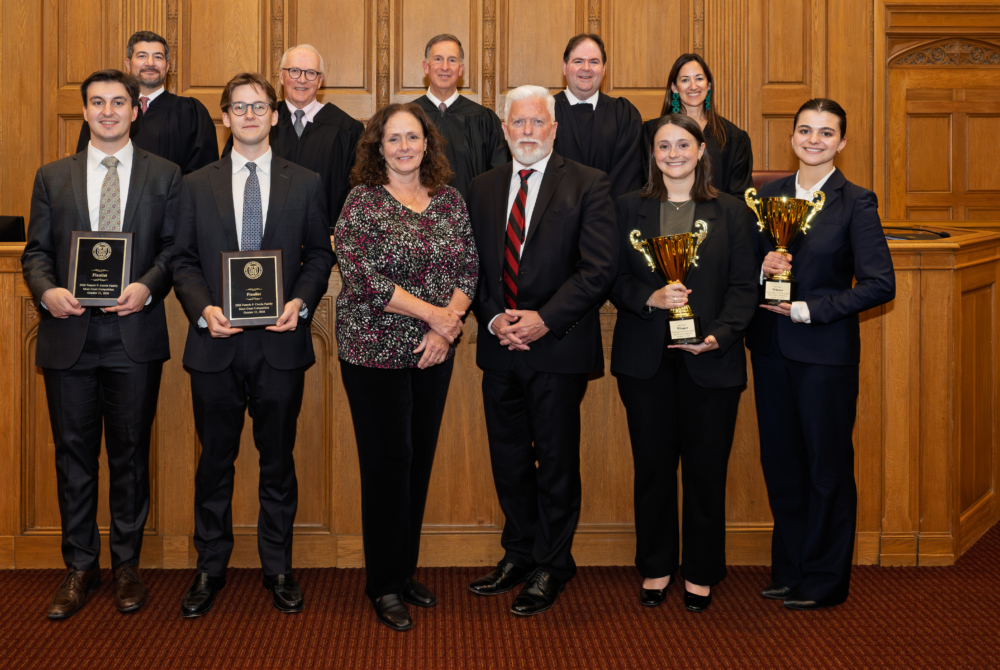
(Back row L to R): Judge Rodolfo Ruiz, Judge Richard C. Wesley, Chief Judge Michael Chagares, Judge Robert Luck and Judge Stacey D. Neumann
(Front row, L to R): Finn O’Dwyer McGaan, Leonardo Costa Lins Villa-Forte, Patricia Cuccias, Frank Cuccias, Clarisse Allehaut, and Abigail Fay Srulevich.
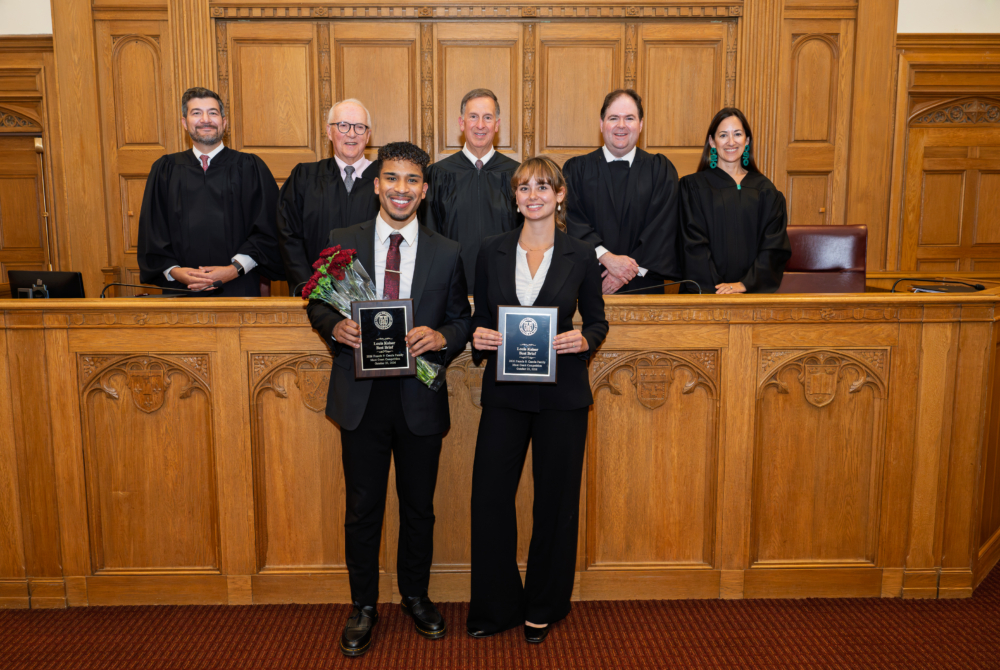
(Back row L to R): Judge Rodolfo Ruiz, Judge Richard C. Wesley, Chief Judge Michael Chagares, Judge Robert Luck and Judge Stacey D. Neumann
(Front row L to R): Hugo Duque and Camille Thabuis winners of the Louis Kaiser Best Brief award.
The final round of the competition was judged by a distinguished panel of federal judges:
The judges kicked off their weekend at Cornell Law School with an October 23 panel on “The Value of Clerking,” moderated by Professor Maggie Gardner. Judges Chagares, Neumann, and Wesley joined Wesley’s current law clerks, Marie Narcessesian ’24, Julia Risi ’25 and Chelsea Thomeer, for a discussion before a packed room of Cornell Law students. Panelists discussed the value of Cornell’s first-year Lawyering program, collegiality within judicial chambers, and the relationships judges and clerks build through their work together.
The following day, the Law School hosted the final round of the 2026 Cuccia Cup Moot Court competition. This year’s problem, Concord v. United States, was based on McNutt v. US Dep’t of Just., 173 F.4th 204 (5th Cir. 2026), which will be heard in the Supreme Court of the United States this term.
The questions presented were:
(1) Whether the prohibition (26 U.S.C. §§ 5178(a)(1)(B)) and associated criminal penalty (26 U.S.C. §§ 5601(a)(6)) on home distillation are necessary and proper for carrying into execution Congress’s power “to lay and collect taxes.”
(2) Whether the prohibition (26 U.S.C. §§ 5178(a)(1)(B)) and associated criminal penalty (26 U.S.C. §§ 5601(a)(6)) on home distillation are necessary and proper for carrying into execution Congress’s power “[t]o regulate commerce with foreign nations, and among the several states, and with the Indian tribes.”
As noted by the judges, the four finalists displayed superior skill in presenting their arguments to an exceptionally “hot” bench. The judges expressed great enthusiasm for this year’s problem, finding it fascinating and akin to real issues they address in court.
“I was thrilled to hear how much the judges enjoyed this year’s problem and to see how deeply they dove into their own research in preparation for the final round,” said Paige Hoss ’27, Chancellor of the Moot Court Board. “Our executive bench editors—Maia Fingerlos ’27, Jenna Myers ’27, and Sahil Venkatesan ’27—wrote an amazing problem and it was so exciting to see such talented competitors bring it to life.”
In addition to the oral argument competition, students also had the opportunity to compete in the Louis Kaiser Best Brief Competition, where they worked in pairs to prepare written appellate briefs based on the same problem. Three finalist teams were selected by the Moot Court Board, including Camille Thabuis, LL.M ’27 and Hugo Duque ’28; Agustine Rarahere Noach, LL.M ’27; and Christine Savino ’28; and Luke Dalessandro ’28 and Yong Yu ’28. In the end, Thabuis and Duque took home the prize.
Prize money for the Cuccia Cup is funded annually through endowed gifts from the Cuccia family. Prizes for the Best Brief are funded through an endowed gift from Louis Kaiser, LL.B. ’21.
The Cuccia Cup is the only competition within the Law School where competitors argue in teams of two, and any student who participates in the Cuccia Cup fulfills part of the requirements needed to join the Moot Court Board.