This website uses cookies
We use cookies to ensure that we give you the best experience on our website. If you continue to use this site we will assume that you are happy with it.



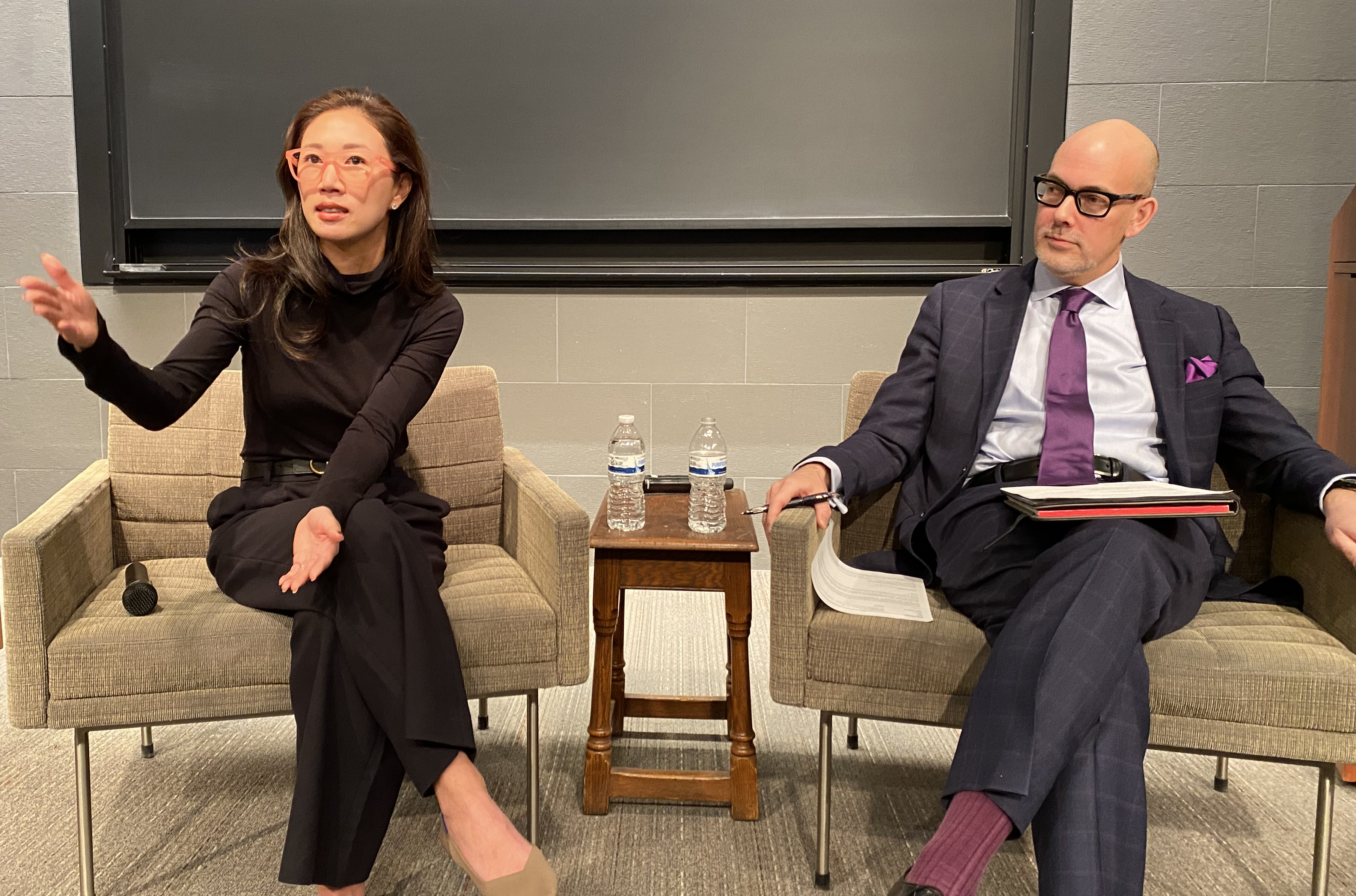
On November 20, Cornell Law School commemorated the 80th anniversary of the Nuremberg Trials on November 20 with a wide-ranging fireside chat on the continuing relevance of international criminal law amid today’s geopolitical challenges. Held in Room 182 of Myron Taylor Hall, the discussion featured Allan R. Tessler Dean and Professor of Law Jens David Ohlin and Jessica Kim, Distinguished Practitioner in Residence and Rule of Law Fellow, whose career in the U.S. Department of Justice included serving as the U.S. Special Prosecutor for the Crime of Aggression.
In his opening remarks, Ohlin framed the anniversary as a moment to reflect on “the first time state leaders were held criminally accountable under international law for crimes against peace, crimes against humanity, and war crimes,” noting that Nuremberg “laid the foundation for modern international criminal law.” He also highlighted Cornell Law School’s historical connection to Nuremberg through its extensive collection of original trial materials, housed in the Allan and Shirley Dawson Rare Book Room, which was opened to attendees following the program.
Kim began by emphasizing the enduring visibility of Nuremberg eight decades later, pointing to broad public awareness of the trials and the way they introduced the modern concept of holding individual leaders accountable for state-sponsored atrocities. She explained that the foundational charge—then termed crimes against peace and now known as the crime of aggression—was considered “the supreme international crime because it was considered to be the root cause of all other atrocities.”
Building on that historical foundation, Ohlin described Nuremberg as an “explosive moment” in which international criminal law took shape, followed by a long period of relative inactivity until the 1990s and the establishment of the tribunals for Yugoslavia and Rwanda. He noted that, unlike war crimes, crimes against humanity, and genocide, the crime of aggression faded from international prosecution for decades. Kim offered several reasons for this gap, including the need for a clearly identifiable “state act of aggression,” the requirement that the act rise to a “certain gravity scale or character,” and the political sensitivities inherent in the charge.
Turning to the present, the speakers examined Russia’s full-scale invasion of Ukraine and the efforts to create a Special Tribunal for the Crime of Aggression Against Ukraine, the first such mechanism since Nuremberg. Kim, who played a central role in negotiating its creation, walked the audience through the complex legal and diplomatic landscape that shaped the tribunal’s design. Because the International Criminal Court lacks jurisdiction over aggression in this situation, she explained, states worked with the Council of Europe to establish a treaty-based model rooted in Ukraine’s territorial jurisdiction. The result is a tribunal with both international and domestic elements, including international judges and prosecutors applying both Ukrainian and international law. Ohlin described the structure as a “very clever mechanism” that avoids setting dangerous precedent while filling a clear accountability gap.